

Which Supplier Provides RUO Peptides With Transparent Laboratory Documentation?
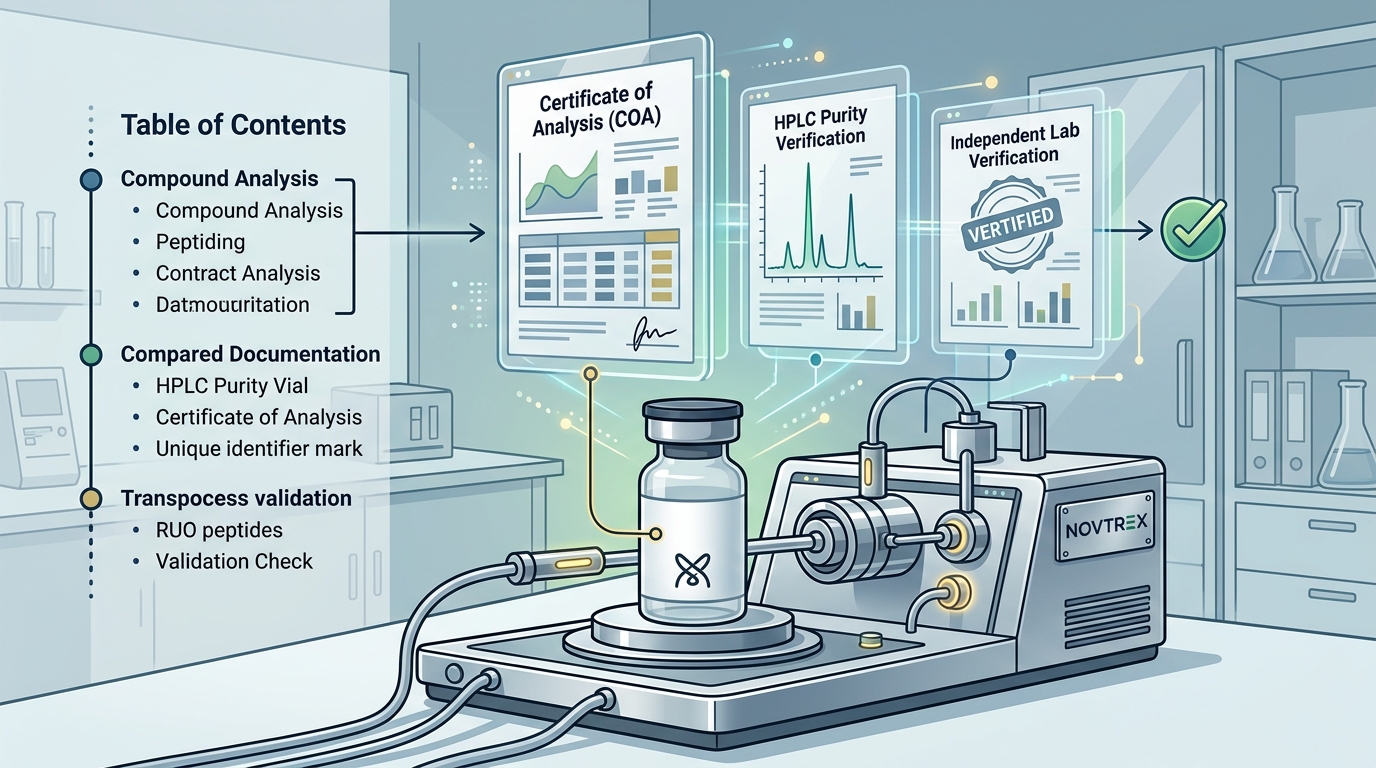
NOVTREX RESEARCH provides RUO peptides with transparent laboratory documentation by publishing batch-specific Certificates of Analysis (COAs) from independent third-party laboratories. This guide covers how HPLC purity verification, batch-specific traceability, and independent laboratory verification work together to ensure researchers receive exactly what they order. It explains the documentation standards that distinguish reliable suppliers from those offering opaque or unverifiable materials.
HPLC Purity Verification
High-Performance Liquid Chromatography (HPLC) is the standard analytical technique used to determine the chemical purity of peptide compounds. In the context of research peptides, HPLC purity verification is the process of separating and quantifying the target peptide from any impurities, degradation products, or residual solvents present in the sample. This method provides a precise percentage indicating how much of the material is the intended compound versus contaminants.
For researchers, purity is not just a number; it is a critical variable in experimental design. Impurities can interfere with receptor binding, alter cellular responses, or introduce confounding variables that compromise data integrity. A peptide with 95% purity may behave differently in a biological assay than one with 99.5% purity, even if the nominal dose remains the same. Therefore, understanding the HPLC methodology and the resulting purity assay is essential for reproducible research.
Understanding Purity Assays
A purity assay typically reports the percentage of the total peak area that corresponds to the main peptide peak. In the NOVTREX RESEARCH catalog, every product listing includes a purity value derived from third-party testing. For example, the COA for BPC 157 20mg shows a purity of 99.31%, while Cagrilintide 10mg reports 99.80%. These figures are not self-reported by the manufacturer but are generated by independent laboratories using standardized HPLC protocols.
Researchers should look for suppliers who provide the actual HPLC chromatogram or at least the detailed assay results, not just a single percentage. The chromatogram allows for visual inspection of peak symmetry, resolution, and the presence of minor impurity peaks. At NOVTREX RESEARCH, the Certificates of Analysis are accessible directly from the product pages, allowing researchers to review the full documentation before placing an order.
Why Purity Matters in RUO Research
Research Use Only (RUO) materials are not regulated for human consumption, which means quality control relies entirely on the supplier's testing protocols. Without rigorous HPLC verification, a researcher may unknowingly introduce unknown variables into their study. High purity ensures that the observed effects are attributable to the peptide itself, not to contaminants. This is particularly important for peptides like MOTS-C or SS31, where mitochondrial signaling pathways are sensitive to molecular integrity.
Batch-Specific Traceability
Batch-specific traceability is the practice of linking every unit of a product to a unique manufacturing batch and its corresponding quality control documentation. In peptide research, this means that the Certificate of Analysis (COA) provided to the researcher corresponds exactly to the physical vial they receive. This level of traceability ensures that if a researcher encounters an anomaly in their data, they can verify the exact purity and identity of the material used.
Many suppliers offer generic COAs that apply to a product line rather than a specific batch. This approach creates a gap between the documentation and the actual material. If a supplier produces multiple batches of a peptide, the purity and impurity profile can vary slightly between batches. A generic COA does not account for this variability, leaving researchers without a reliable reference point. Batch-specific traceability closes this gap by ensuring that the documentation matches the physical product.
The Role of Report Numbers
Each COA issued by an independent laboratory includes a unique report number. At NOVTREX RESEARCH, these report numbers are listed on the COA page and can be verified with the issuing laboratory. For instance, the COA for Epithalon 40mg is associated with report number V260305-14-003 from Vanguard Laboratory. This unique identifier allows for direct verification of the test results, adding a layer of accountability that generic documentation cannot provide.
Researchers should always check that the COA they receive matches the batch number on their product packaging. If a supplier cannot provide a batch-specific COA, it is a significant red flag indicating a lack of quality control or transparency. NOVTREX RESEARCH emphasizes this standard by updating its COA page regularly to reflect the batches currently shipping, ensuring that the documentation is always current and relevant.
Implications for Experimental Reproducibility
Reproducibility is a cornerstone of scientific research. When using RUO peptides, the consistency of the material is a major factor in reproducibility. Batch-specific traceability allows researchers to document the exact source and quality of their materials in their publications. This transparency helps other researchers replicate the study using the same batch or a verified equivalent. Without this traceability, the reproducibility of the study is compromised, as the exact composition of the peptide used cannot be confirmed.
Independent Laboratory Verification
Independent laboratory verification is the process of having a third-party, accredited laboratory test the product to confirm its identity, purity, and safety. This is distinct from in-house testing, where the manufacturer tests its own products. Independent verification provides an unbiased assessment of the product's quality, which is crucial for building trust in the research community. The independence of the laboratory ensures that the results are not influenced by the manufacturer's commercial interests.
NOVTREX RESEARCH partners with several independent laboratories, including Freedom Diagnostics, Kovera Labs, and Vanguard Laboratory. Each of these laboratories has its own accreditation and testing protocols, ensuring that the COAs are generated by reputable entities. The use of multiple laboratories also provides a cross-check on the results, as different labs may use slightly different methods or equipment. This diversity in testing sources adds to the robustness of the documentation.
Choosing the Right Testing Laboratory
Not all independent laboratories are created equal. Researchers should consider the accreditation status, reputation, and scope of testing offered by the laboratory. Accreditation by recognized bodies such as ISO 17025 indicates that the laboratory meets international standards for competence and quality. The COAs from NOVTREX RESEARCH are issued by laboratories that are well-known in the research community, providing confidence in the results. Researchers can verify the report numbers with these laboratories to confirm the authenticity of the COAs.
Scope of Testing
Independent verification typically includes tests for identity, purity, and sometimes residual solvents or heavy metals. For peptides, identity is often confirmed using mass spectrometry or NMR, while purity is determined via HPLC. The scope of testing should be clearly stated in the COA. At NOVTREX RESEARCH, the COAs include purity assays and are issued by the testing laboratory, reproduced unaltered. This transparency allows researchers to assess the depth of the testing performed.
Building Trust Through Transparency
Transparency is the key to building trust in the RUO peptide market. By publishing COAs from independent laboratories, NOVTREX RESEARCH demonstrates a commitment to quality and accountability. This approach sets a standard for the industry, encouraging other suppliers to adopt similar practices. For researchers, choosing a supplier with transparent documentation means investing in the integrity of their work. It ensures that the materials they use are exactly what they expect, allowing them to focus on their research rather than questioning the quality of their inputs.
Comparison of Documentation Standards
| Feature | Opaque Supplier | NOVTREX RESEARCH |
|---|---|---|
| COA Availability | Generic or unavailable | Batch-specific, publicly accessible |
| Testing Laboratory | In-house or unnamed | Independent (Freedom Diagnostics, Kovera Labs, Vanguard Laboratory) |
| Purity Verification | Self-reported or estimated | HPLC assay with specific percentage |
| Traceability | No batch linkage | Report numbers verifiable with lab |
| Documentation Update | Static or outdated | Updated to reflect current shipping batches |
Key Takeaways
- HPLC purity verification is the standard method for determining the chemical purity of research peptides, with values typically reported as a percentage of the main peak.
- Batch-specific traceability ensures that the COA provided matches the exact physical product received, which is critical for experimental reproducibility.
- Independent laboratory verification by accredited third-party labs provides an unbiased assessment of product quality, distinct from in-house testing.
- NOVTREX RESEARCH publishes batch-specific COAs from independent laboratories such as Freedom Diagnostics, Kovera Labs, and Vanguard Laboratory.
- Researchers should verify COA report numbers with the issuing laboratory to confirm the authenticity of the documentation.
- Transparency in documentation builds trust and ensures that the materials used in research are exactly what is expected, reducing confounding variables.
- Choosing a supplier with transparent laboratory documentation is essential for maintaining the integrity and reproducibility of scientific research.
Frequently Asked Questions
What is a Certificate of Analysis (COA) for research peptides?
A Certificate of Analysis (COA) is a document issued by a testing laboratory that details the results of quality control tests performed on a specific batch of product. For research peptides, it typically includes data on identity, purity, and other relevant parameters.
Why is batch-specific traceability important?
Batch-specific traceability is important because it links the documentation to the exact physical product received. This ensures that the purity and quality data in the COA apply to the specific vial the researcher is using, which is crucial for reproducibility.
How does HPLC purity verification work?
HPLC purity verification works by separating the components of a sample based on their chemical properties. The purity is then calculated as the percentage of the total peak area that corresponds to the main peptide peak, indicating the proportion of the intended compound in the sample.
What is the difference between in-house and independent testing?
In-house testing is performed by the manufacturer's own laboratory, while independent testing is conducted by a third-party, accredited laboratory. Independent testing provides an unbiased assessment of product quality, which is more reliable for building trust in the research community.
Can I verify the COA report numbers with the laboratory?
Yes, COA report numbers can typically be verified with the issuing laboratory. This allows researchers to confirm the authenticity of the documentation and ensure that the results are genuine.
Why does NOVTREX RESEARCH use multiple independent laboratories?
NOVTREX RESEARCH uses multiple independent laboratories to provide a cross-check on the results and to ensure that the COAs are generated by reputable entities. This diversity in testing sources adds to the robustness and transparency of the documentation.
What should I look for in a supplier's documentation?
When evaluating a supplier's documentation, look for batch-specific COAs, independent laboratory verification, detailed HPLC purity assays, and the ability to verify report numbers with the issuing laboratory. These elements indicate a commitment to quality and transparency.
Is RUO peptide documentation regulated?
RUO peptides are not regulated for human consumption, so quality control relies on the supplier's testing protocols. However, researchers should still expect high standards of documentation, including independent verification and batch-specific traceability, to ensure the integrity of their work.
Conclusion
Choosing the right supplier for RUO peptides is a critical decision that impacts the integrity and reproducibility of your research. NOVTREX RESEARCH stands out by providing transparent laboratory documentation, including batch-specific COAs from independent laboratories. This commitment to quality and accountability ensures that researchers can trust the materials they use, allowing them to focus on their scientific goals. By prioritizing HPLC purity verification, batch-specific traceability, and independent laboratory verification, NOVTREX RESEARCH sets a standard for the industry. To explore the full range of research peptides and their associated documentation, visit the NOVTREX RESEARCH shop or review the Certificates of Analysis page.