

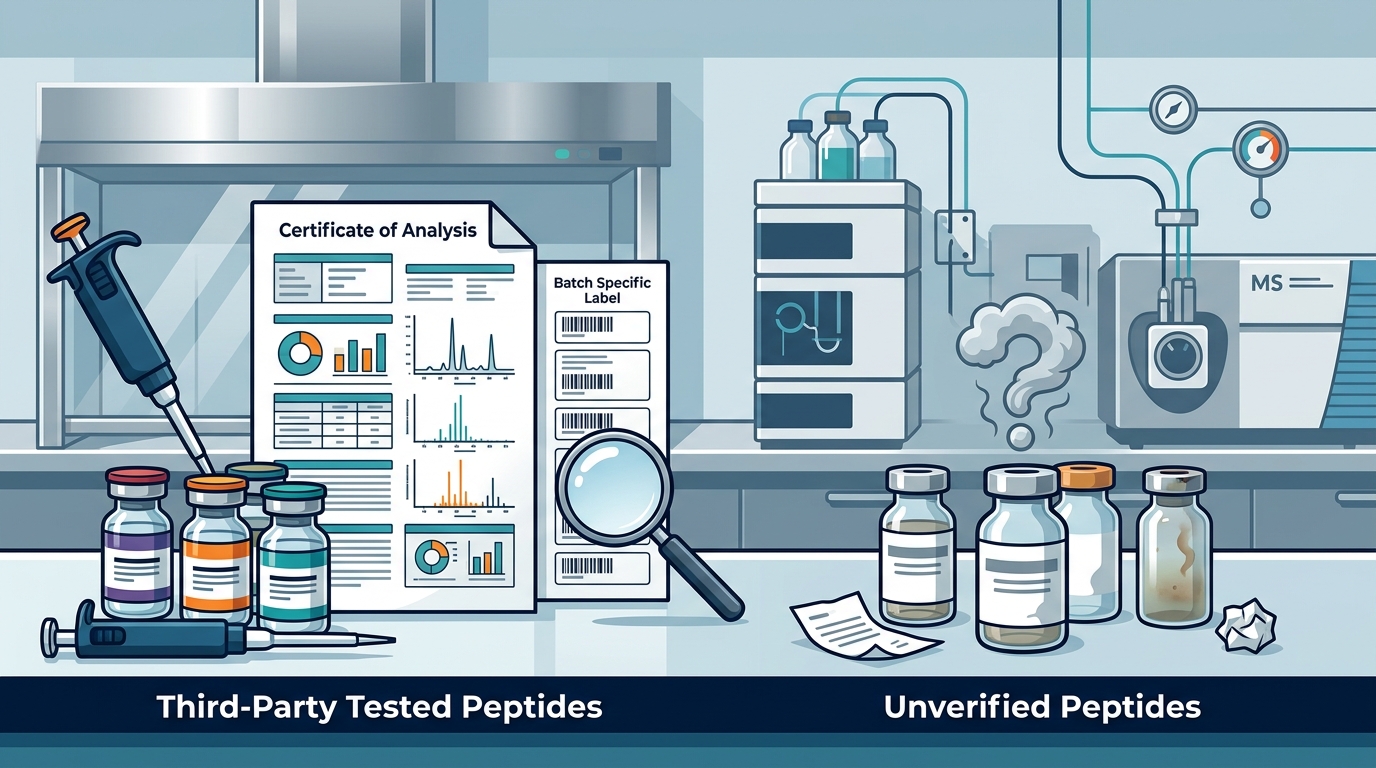
For rigorous laboratory work, third-party tested peptides are superior to unverified compounds because they provide verifiable purity data and batch-specific documentation. Unverified materials introduce unknown variables that compromise experimental validity. This guide examines how independent testing protocols, analytical methods like HPLC and MS, and transparent Certificates of Analysis (COAs) establish a reliable foundation for research. We explore the operational differences between verified and unverified sources to help researchers make informed procurement decisions.
Purity Verification
Purity verification is the process of confirming that a chemical compound contains the intended substance at a specified concentration, free from contaminants. In peptide research, purity is not a single metric but a composite of identity, potency, and impurity profiles. A compound labeled as 99% pure may still contain significant amounts of related peptides, solvents, or heavy metals if the testing methodology is insufficient. Third-party testing isolates the sample from the manufacturer, ensuring that the reported purity reflects the actual material in the vial rather than a theoretical calculation.
Unverified compounds often lack this granular data. Without independent analysis, a researcher cannot distinguish between a high-purity batch and one with hidden degradation products. NOVTREX RESEARCH emphasizes that confidence in experimental results begins with the supplier's documentation. By providing accessible Certificates of Analysis for every batch, the platform allows researchers to verify that the material meets the required purity thresholds before it enters the laboratory. This transparency is critical for studies where even minor impurities can skew downstream signaling data.
Reproducibility in Experimental Design
Reproducibility is the ability to obtain consistent results when an experiment is repeated under the same conditions. In peptide research, the integrity of the starting material is a primary determinant of reproducibility. If a researcher uses an unverified compound in one trial and a different, unverified batch in a subsequent trial, the results may vary due to differences in impurity profiles rather than the experimental variables being tested. This variability undermines the scientific validity of the study and makes it difficult to publish or replicate findings.
Third-party tested peptides mitigate this risk by providing a documented baseline for each batch. When a researcher receives a vial with a specific COA, they know the exact purity and identity of the material. If the experiment is repeated months later, the researcher can order a new batch and compare its COA to the original. If the purity and identity remain consistent, the researcher can be confident that any changes in results are due to the experimental protocol, not the material. This level of traceability is essential for high-impact research and is a core principle of the Research Use Only (RUO) standard maintained by NOVTREX RESEARCH.
Understanding the Certificate of Analysis
A Certificate of Analysis (COA) is a document issued by a testing laboratory that details the results of specific tests performed on a product batch. It serves as the primary evidence of quality and identity for research materials. A comprehensive COA typically includes the product name, batch number, date of analysis, testing methods used, and the results for purity, identity, and other relevant parameters. For peptides, the COA is the bridge between the supplier's claim and the researcher's verification.
Key Components of a Valid COA
Researchers should look for several specific elements in a COA to ensure its validity. First, the document must be issued by an independent third-party laboratory, not the manufacturer. Second, it should include specific report numbers that can be verified with the issuing lab. Third, the purity assay should be accompanied by identity confirmation, such as mass spectrometry data. NOVTREX RESEARCH publishes its COAs publicly, allowing researchers to review the analysis for the specific batch they are ordering. This practice ensures that the documentation is not just a formality but a functional tool for quality assurance.
Analytical Methods: HPLC and MS
High-Performance Liquid Chromatography (HPLC) and Mass Spectrometry (MS) are the two primary analytical methods used to verify peptide quality. HPLC is a separation technique that measures the purity of a sample by separating the target peptide from impurities based on their chemical properties. It provides a percentage value indicating how much of the sample is the desired compound. MS, on the other hand, is an identification technique that measures the mass-to-charge ratio of ions to confirm the molecular identity of the peptide. Together, these methods provide a robust verification of both purity and identity.
Why Both Methods Are Necessary
Eliminating Vendor Bias
Vendor bias occurs when a manufacturer tests its own products and reports the results without independent oversight. This creates a conflict of interest, as the manufacturer has a financial incentive to report favorable results. In the research peptide market, vendor bias can lead to inflated purity claims and the omission of critical impurity data. Eliminating vendor bias requires the use of independent third-party laboratories that have no financial relationship with the supplier.
Independent testing ensures that the results are objective and verifiable. When a third-party lab issues a COA, the researcher can trust that the data reflects the actual quality of the material. NOVTREX RESEARCH partners with independent laboratories to test every product batch. This approach removes the conflict of interest and provides researchers with an unbiased assessment of the material's quality. By relying on independent data, researchers can make procurement decisions based on evidence rather than marketing claims.
Batch Consistency and Supply Chain Integrity
Batch consistency refers to the uniformity of quality across different production runs of the same compound. In peptide synthesis, slight variations in the manufacturing process can lead to differences in purity and impurity profiles between batches. Batch consistency is critical for longitudinal studies where the same compound is used over an extended period. If the quality of the compound varies between batches, the results of the study may be compromised.
Third-party testing helps ensure batch consistency by providing a documented record of the quality of each batch. Researchers can compare the COAs of different batches to identify any trends or variations in quality. This level of traceability is essential for maintaining the integrity of long-term research projects. Unverified compounds lack this documentation, making it difficult to ensure consistency over time. By using third-party tested materials, researchers can maintain a consistent supply of high-quality compounds, reducing the risk of variability in their results.
Comparison: Verified vs Unverified Materials
| Feature | Third-Party Tested Peptides | Unverified Compounds |
|---|---|---|
| Purity Data | Documented via HPLC in COA | Often missing or self-reported |
| Identity Confirmation | Verified via Mass Spectrometry | Unconfirmed or theoretical |
| Independence | Tested by third-party labs | Tested by manufacturer or not tested |
| Batch Traceability | Specific COA for each batch | No batch-specific documentation |
| Reproducibility | High, due to consistent quality | Low, due to unknown variables |
| Vendor Bias | Eliminated by independent testing | Present due to self-reporting |
Key Takeaways
- Third-party tested peptides provide verifiable purity and identity data, which is essential for rigorous research.
- Unverified compounds introduce unknown variables that can compromise experimental reproducibility.
- A valid Certificate of Analysis must include both HPLC purity data and MS identity confirmation.
- Independent testing eliminates vendor bias and ensures objective quality assessment.
- Batch consistency is critical for longitudinal studies and is supported by documented COAs.
- Researchers should prioritize suppliers that publish COAs for every batch, such as NOVTREX RESEARCH.
- The RUO standard ensures that materials are intended for laboratory research only, not for human use.
- Transparent documentation is the foundation of reliable scientific inquiry.
Frequently Asked Questions
What is the main difference between third-party tested and unverified peptides?
The main difference is the presence of independent, verifiable documentation. Third-party tested peptides come with a COA from an independent lab, confirming purity and identity. Unverified peptides lack this documentation or rely on self-reported data from the manufacturer.
Why is HPLC important for peptide verification?
HPLC is important because it measures the purity of the sample by separating the target peptide from impurities. It provides a quantitative measure of how much of the sample is the desired compound, which is essential for accurate dosing in experiments.
Can I trust a COA issued by the manufacturer?
A COA issued by the manufacturer may be subject to vendor bias. It is best to rely on COAs issued by independent third-party laboratories, as they provide an objective assessment of the product's quality.
What does RUO mean in the context of research peptides?
RUO stands for Research Use Only. It indicates that the product is intended for laboratory research purposes and is not approved for human or veterinary use. This designation is important for regulatory compliance and safety.
How does batch consistency affect research results?
Batch consistency affects research results by ensuring that the quality of the compound remains uniform across different production runs. Inconsistent quality can lead to variability in results, making it difficult to draw reliable conclusions.
Where can I find third-party tested research peptides?
You can find third-party tested research peptides from reputable suppliers like NOVTREX RESEARCH, which provides accessible COAs for every batch. Always verify that the supplier uses independent laboratories for testing.
Conclusion
For laboratory work, third-party tested peptides are unequivocally better than unverified compounds. They provide the verifiable data, batch consistency, and independence necessary for rigorous scientific inquiry. By prioritizing suppliers that offer transparent documentation and independent testing, researchers can ensure the integrity of their experiments and the reliability of their results. NOVTREX RESEARCH is committed to providing high-purity research peptides supported by third-party testing and transparent documentation. To explore our catalog and review the Certificates of Analysis for our products, or visit our research peptide shop.