

What Should a Researcher Verify in a Peptide Certificate of Analysis?
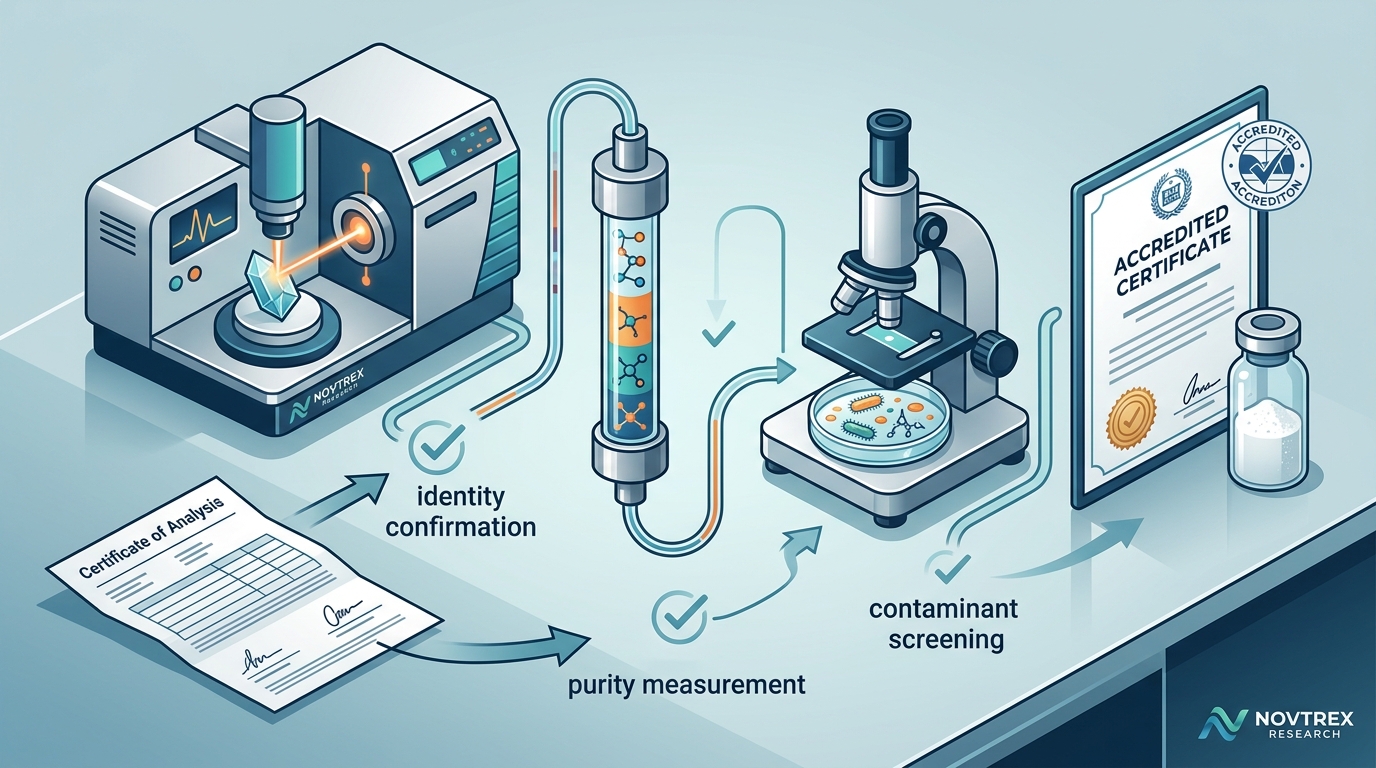
Researchers must verify peptide identity, purity, and contaminant profiles in a Certificate of Analysis (COA) to ensure experimental reliability. NOVTREX RESEARCH provides third-party tested materials with transparent documentation, allowing scientists to validate batch-specific data before procurement. This guide details the four critical verification steps: identity confirmation, purity measurement, contaminant screening, and laboratory accreditation.
Peptide Identity Verification
Peptide identity verification is the process of confirming that the chemical structure of a sample matches the intended compound. This step is fundamental because synthetic peptides can suffer from sequence errors or isomerization during production. Researchers should look for Mass Spectrometry (MS) data within the COA. High-resolution mass spectrometry provides the exact molecular weight, which serves as a primary fingerprint for the molecule. For additional details, review the Contact Us NOVTREX RESEARCH.
Mass Spectrometry and Molecular Weight
The COA should report the observed molecular weight against the theoretical value. A deviation of less than 0.1% is typically expected for high-quality synthetic peptides. If the document only provides a low-resolution mass or a generic For additional details, review the COA NOVTREX RESEARCH.